One source of existence
Everything in the heavens and the earth depends on Allah. The Creator is not part of creation and is not limited as created things are.
The heart of Islam is a simple, profound truth: there is only One God, unique and without equal. Explore the meaning of Tawḥīd — a belief that shapes worship, character, purpose and the way Muslims understand the world.
A note for readers: The images and patterns on this page are decorative. In Islam, Allah is not represented through a picture or physical likeness.
The Arabic word Allah means God. Muslims believe that Allah alone created and sustains everything, knows all things and deserves worship without partners or intermediaries. This belief is called Tawḥīd — affirming Allah's absolute oneness.
Everything in the heavens and the earth depends on Allah. The Creator is not part of creation and is not limited as created things are.
Prayer, trust, gratitude and supplication are ultimately directed to Allah alone. No created being is worshipped alongside Him.
Allah is neither human nor an object. The Qur'an teaches that nothing resembles Him, even as He hears and sees all things.
“There is nothing like Him, and He is the All-Hearing, All-Seeing.”
In just four short verses, Surah al-Ikhlāṣ (Chapter 112) expresses the essence of the Islamic understanding of Allah. Read each line, hear it recited, then learn it by heart.
Tap the play button beside a verse to hear it, and Transliteration for pronunciation. When you are ready, switch on Test yourself: the Arabic is hidden until you tap a line.
Tap a line to reveal it. Try saying it from memory first.
Tawḥīd comes from the Arabic root related to making or affirming something as one. Islamic scholars explain its meaning through different teaching frameworks. A useful way to begin is with three connected truths.
He alone creates, provides, gives life and governs existence. Life and the universe are neither independent of Him nor outside His knowledge.
Knowing Allah is the Creator leads to worshipping Him alone: prayer, surrender, duʿāʾ and ultimate reliance are for Him, not idols or other beings.
The Qur'an describes Allah with beautiful names and perfect attributes. Muslims affirm these without comparing Allah to creation.
Tap a reference to read the verse, with its translation and recitation, without leaving the page.
Your God is One God. There is no deity worthy of worship except Him, the Entirely Merciful, the Especially Merciful.
Allah, the angels and those of knowledge bear witness that there is no god but Him, upholding justice.
Hearts find rest in the remembrance of Allah. Tawḥīd is meant to bring calm, not only correct belief.
Whether you say “Allah” or “ar-Raḥmān”, the most beautiful names belong to Him.
Three verses that name Allah as the Knower, the King, the Source of Peace, the Creator, the Fashioner and more.
“My prayer, my sacrifice, my living and my dying are for Allah, Lord of the worlds. He has no partner.”
When the Prophet Muhammad ﷺ passed away, the Companions were overwhelmed by grief. Abū Bakr al-Ṣiddīq رضي الله عنه reminded the community that the Messenger ﷺ was beloved and obeyed, but Allah alone is worshipped. Allah's life has no end.
“Whoever among you worshipped Muhammad, Muhammad has died. But whoever worships Allah, Allah is Ever-Living and does not die.”
Selected passage · Ṣaḥīḥ al-Bukhārī 3667 · Complete narration
He then recited Qur’an 3:144, reminding believers that the Prophet ﷺ was a messenger and that the message of worshipping Allah remains. This historical moment illustrates the same teaching expressed in Āyat al-Kursī: Allah is al-Ḥayy, the Ever-Living.
Qur'an 2:255 is known as Āyat al-Kursī, the Verse of the Kursī. It draws together some of the most majestic descriptions of Allah.
Allah — there is no deity worthy of worship except Him, the Ever-Living, the Sustainer of all.
Allah's life does not begin or end. Human life is temporary and dependent; His is neither.
There is no exhaustion, weakness or need for rest in Allah's preservation of creation.
Allah knows the past, present and future. Human beings know only what they are permitted to learn.
Everything belongs to Him, and nothing lies outside His power or care.
The Qur'an invites believers to call upon Allah by His most beautiful names. Each name teaches something about His perfection and guides how Muslims pray, hope and behave.
The Entirely Merciful
The Especially Merciful
The King
The Most Holy
The Source of Peace
The Giver of Security
The Guardian
The Almighty
The Compeller
The Supreme in Greatness
The Creator
The Originator
The Fashioner
The Repeatedly Forgiving
The Subduer
The Bestower
The Provider
The Opener
The All-Knowing
The Withholder
The Expander
The Abaser
The Exalter
The Giver of Honour
The Giver of Dishonour
The All-Hearing
The All-Seeing
The Judge
The Utterly Just
The Subtle, the Gentle
The All-Aware
The Forbearing
The Magnificent
The Ever-Forgiving
The Most Appreciative
The Most High
The Most Great
The Preserver
The Sustainer
The Reckoner
The Majestic
The Most Generous
The Watchful
The Responsive
The All-Encompassing
The All-Wise
The Most Loving
The Glorious
The Resurrector
The Witness
The Absolute Truth
The Trustee
The All-Strong
The Firm
The Protecting Friend
The Praiseworthy
The Accounter
The Originator
The Restorer
The Giver of Life
The Bringer of Death
The Ever-Living
The Self-Sustaining
The Finder
The Noble
The One
The Unique
The Eternal Refuge
The All-Able
The All-Powerful
The Expediter
The Delayer
The First
The Last
The Manifest
The Hidden
The Governor
The Most Exalted
The Source of Goodness
The Ever-Accepting of Repentance
The Avenger
The Pardoner
The Most Kind
Owner of All Sovereignty
Lord of Majesty and Generosity
The Equitable
The Gatherer
The Self-Sufficient
The Enricher
The Preventer
The Distresser
The Benefactor
The Light
The Guide
The Incomparable Originator
The Everlasting
The Inheritor
The Guide to the Right Path
The Patient
Recitation uses your device's Arabic voice. If you hear nothing, add an Arabic voice in your phone or computer's speech settings. Scholars differ over exactly which ninety-nine names are meant, and lists vary slightly; this is the widely used list.
“To Allah belong the most beautiful names, so call upon Him by them.”
Many of the names appear together in Surah Al-Ḥashr (59:22–24). The Qur'an also says that whichever name a person calls upon, the best names belong to Allah (Surah Al-Isrāʾ (17:110)).
The Prophet ﷺ taught the special virtue of learning and preserving Allah's ninety-nine names. This does not mean Allah's names are necessarily limited to only ninety-nine. Ṣaḥīḥ Muslim 2677a
Beyond study, the names have always had a devotional life. Muslims call upon Allah by them in duʿāʾ, recite them in dhikr (remembrance), and treasure them as a reminder of His presence. Many describe this as a spiritual dimension of belief: knowing a name with the mind, then turning to Allah by it with the heart.
The Qur'an tells believers to call on Allah by His most beautiful names and to remember Him often. Many Muslims recite names such as Ar-Raḥmān, Al-Laṭīf or Al-Ghafūr after prayer or in morning and evening remembrance, choosing the name that fits their need.
In many Sufi orders (ṭuruq), the names are recited in gatherings of dhikr, and sometimes given by a teacher as a personal litany (wird) with a set number of repetitions. Sufism has historically flourished alongside the Ashʿarī and Māturīdī traditions, and many scholars have valued these gatherings as a way of softening the heart and increasing love for Allah.
Many families display the names, or Āyat al-Kursī, in calligraphy at home as a reminder of Allah and in hope of His blessing (barakah) on the household. Scholars stress that the writing is a reminder and a way of turning to Allah, never a charm: protection and blessing come from Allah alone.
Scholars differ over some forms, such as fixed counts, loud collective recitation or gatherings with movement. Some, especially in the traditionalist (Atharī) current, prefer individual dhikr in the words and times reported in the Sunnah. Please ask your teacher or imam about the practice you follow. Imam al-Ghazālī's al-Maqṣad al-Asnā is a classic reflection on the meanings of the names.
Before Islam, Arabian religious life was diverse. Many communities honoured multiple deities, while Jews, Christians and some individuals who sought Abrahamic monotheism also lived in and around Arabia. The Qur'an challenged worship directed to idols or intermediaries and called people back to Allah alone.
In Islamic teaching, Ibrahim and Ismāʿīl raised the foundations of the Kaʿbah for worship of the One God (Al-Baqarah 2:127). Across generations, idol practices developed around the sanctuary. The Prophet Muhammad ﷺ called Makkah back to Tawḥīd.
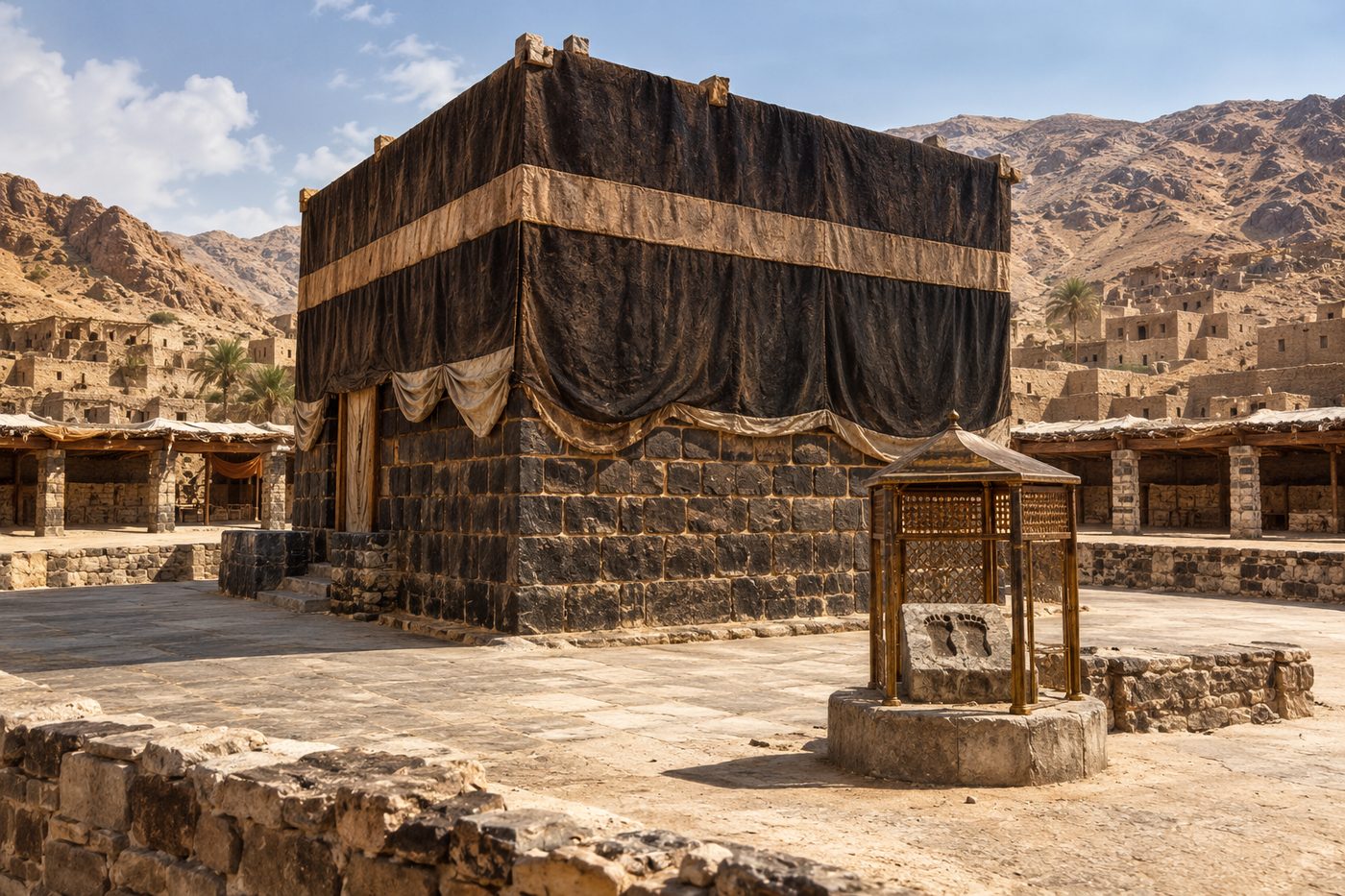
In this context, polytheism means devotion to multiple deities, while idolatry means directing acts of worship towards images or objects. Some worshippers saw such figures as intermediaries; the Qur'an challenges this reasoning in Surah Az-Zumar (39:3). Not all Arabs shared one belief system.
Names associated with Arabian worship included al-Lāt, al-ʿUzzā and Manāt, mentioned in Surah An-Najm (53:19–20).
According to the authentic narration of ʿAbdullāh ibn Masʿūd, there were 360 idols around the Kaʿbah when the Prophet ﷺ entered Makkah. He struck them with a stick while reciting a verse about truth overcoming falsehood. This was a particular historical event of the conquest, not an instruction for individuals to damage other people's property today.
“And say: Truth has come, and falsehood has vanished. Surely falsehood is bound to vanish.”
Muslims believe that the prophets — from Ādam to Nūḥ, Ibrāhīm, Mūsā, ʿĪsā and Muḥammad (peace be upon them all) — called people to worship the One God.
His people were invited to leave false objects of worship and turn sincerely to their Lord.
Ibrāhīm challenged the worship of powerless idols and turned toward the Creator of the heavens and earth.
Mūsā was sent to Pharaoh with signs and an invitation to recognise Allah's authority.
His call in Makkah centred on worshipping Allah alone, giving up idols and living with justice and compassion.
“We surely sent a messenger to every community, saying, ‘Worship Allah and shun false gods.'”
Surah Al-Anbiyāʾ (21:51–67) tells how Prophet Ibrahim challenged the worship of handmade idols. Rather than portraying him, the Qur'anic narrative below lets his questions take centre stage.
Ibrahim asked his people why they were devoted to images. They pointed to the customs of their forefathers; he urged them to examine what those objects could truly do.
When the people departed, Ibrahim broke the idols into pieces, leaving the largest. The story makes a powerful point: the objects themselves had no power to protect one another.
When confronted, Ibrahim directed them to ask the largest figure, if it could speak. The challenge exposed the contradiction of expecting powerless images to hear, help or protect.
His message called people to recognise Allah, Lord of the heavens and earth, rather than worship created objects. The story is an invitation to use reason alongside revelation.
“So he broke them into pieces, except the largest of them, so that they might turn to it.”
The first pillar of Islam is the testimony of faith. Its first half declares that no one deserves worship except Allah; its second recognises Muḥammad ﷺ as His messenger.
“I bear witness that there is no god worthy of worship except Allah, and I bear witness that Muḥammad is the Messenger of Allah.”
It rejects directing worship to anything other than Allah, and affirms that He alone has the right to be worshipped. It is not merely a statement about the number of gods; it is a commitment of heart and action.
Muslims learn how to worship through the teachings and example of the Messenger of Allah ﷺ, as preserved in the Qur'an and authentic Sunnah.
Muslims may call upon Allah directly, at any place and time. Scholars and teachers can help people learn, but prayer to Allah does not require a priest or intermediary.
Our Discover Islam guide provides a gentle introduction and information about arranging a Shahādah visit to Masjid al-Noor.
Tap a reference to read the narration in Arabic and English.
The Prophet ﷺ taught Muʿādh (RA) what Allah's right over His servants is, and what their right is over Him.
In the hadith of Jibrīl, the Prophet ﷺ explained īmān: belief in Allah, His angels, His books, His messengers, the Last Day and the divine decree.
ʿUthmān (RA) reported the Prophet's ﷺ promise of Paradise for the one who dies knowing that there is no god but Allah.
A ḥadīth qudsī: Allah says He is as His servant expects Him to be, and is with him when he remembers Him.
Shirk means associating partners with Allah in what belongs to Him alone, above all worship. The Qur'an calls it a great wrong (Surah Luqmān (31:13)) and invites people back to worshipping Allah alone.
Prayer, supplication, sacrifice and ultimate reliance belong to Allah alone. Giving any of them to a created being, whether a person, an idol, a star or an idea, is the clearest form of shirk.
Scholars also warn about quieter forms, such as doing good in order to be praised instead of for Allah. This is why sincerity (ikhlāṣ) matters in every act.
The best protection is knowing Allah through His names, remembering Him often, and asking Him to keep your heart firm on His path.
No. Muslims honour him, follow his example and send blessings on him, but worship belongs to Allah alone. He is revered as a prophet and messenger, not as divine.
Allah is simply the Arabic word for God. Arabic-speaking Christians use it too. Muslims believe Allah is the Lord of all people.
The Ka‘bah is a shared direction of prayer that unites Muslims. Worship is directed to Allah alone. Chapter 3 explores it.
Belief is the starting point. Tawḥīd is also a commitment of heart and action: directing worship, trust and hope to Allah and living by that commitment.
The Qur'an describes Allah as near to those who call on Him, and every chapter but one opens with His mercy.
No. Muslims honour Ādam, Nūḥ, Ibrāhīm, Mūsā, ʿĪsā and all of Allah's messengers (peace be upon them), who all called to worship Allah alone.
Tawḥīd also helps readers understand where Islam agrees and disagrees with other religious traditions. This section presents the Islamic position without dismissing the dignity or sincerity of people of other faiths.
Muslims revere Jesus as the Messiah, born miraculously to Maryam, a prophet who performed signs by Allah's permission. Islam does not regard him as God or a part of God, and it directs worship to Allah alone.
The Qur'an addresses Christian claims about Jesus' divinity and the Trinity in Surah An-Nisāʾ (4:171) and Surah Al-Māʾidah (5:72–73).
Mainstream Trinitarian Christians affirm one God, understood as Father, Son and Holy Spirit, and believe Jesus is fully divine and fully human—not merely an ordinary man whom they later decided to worship. Muslims reject incarnation and the Trinity because Allah is utterly one and unlike creation.
Understanding this difference accurately makes dialogue more respectful. The Islamic critique concerns theology, not the worth or rights of Christians as people.
One of the clearest differences between the Qur'an and the Christian account is how Jesus' time on earth ended. Muslims believe Allah protected and raised him, and that he will return.
The Qur'an says they did not kill him and did not crucify him, but it was made to appear so to them. Commentators differ on the details of how, and agree that Allah saved him.
Allah says He will take Jesus and raise him to Himself, and that He raised him to Himself. Mainstream Sunni scholars understand this as Jesus being raised alive to the heavens, not dying on the cross.
Muslims believe Jesus will descend before the Day of Judgement as a just ruler, following the law of Muḥammad ﷺ, not as a new prophet. Many commentators understand him to be a sign of the Hour.
Qur'an 43:61 · Ṣaḥīḥ al-Bukhārī 3448 · Ṣaḥīḥ al-Bukhārī 3449
The Prophet ﷺ described Jesus descending among the Muslims as a fair judge. Scholars explain that "breaking the cross" shows the claim built on it to be false, and that he will rule with justice rather than bring a new religion. The narrations also say he will pray with the Muslims behind their own imam, which is why the Prophet ﷺ asked how people will feel when "your imam is from among you".
This is held as part of the Sunni creed, among the major signs before the Day of Judgement.
The crucifixion and resurrection are the heart of the Christian faith, and Muslims do not share that account. Muslim belief is not a rejection of Jesus but an honouring of him: a messenger protected by Allah, raised by Him, and returning in justice.
It also fits Tawḥīd: only Allah is God, and Allah honours and protects His messengers.
Classical Muslim scholars wrote treatises and poetry addressing Christian beliefs. This poem, attributed to Imam Ibn Qayyim al-Jawziyya (d. 751 AH / 1350 CE), is presented as part of that historical literature. It sits alongside this section's respect for Christians as people and its call for courteous discussion.
Arabic text and English translation: Sunnah College (MahadSunnah.com), revised under the scholarly supervision of Sheikh Dr. Haytham Sarhaan. Transliteration prepared for this page.
Masjid al-Noor is a Sunni mosque. Sunni theology is not a single school but a tradition that honours three main schools of ʿaqīdah: the Ashʿarī, the Māturīdī and the Atharī. This section introduces each with respect, and shows how all three affirm what Allah has affirmed for Himself while negating whatever does not befit Him.
The belief in One Allah began with revelation, not Greek philosophy. As Muslim societies expanded, scholars encountered new questions, rival interpretations and philosophical ideas. They developed different ways to explain and defend the creed while remaining grounded in the Qur'an and Sunnah.
During the early centuries of Islam, Muslim scholars debated the nature of Allah's attributes, human freedom, divine justice and the status of the Qur'an. These debates began within the Muslim community as well as in encounters with Christians, Jews and other intellectual traditions. The later translation of Greek philosophical and scientific works into Arabic introduced further concepts and forms of argument. Greek thought was therefore an important influence, but not the only cause, of theological debate.
ʿIlm al-kalām (عِلْمُ الْكَلَامِ), often called systematic or dialectical theology, was one response: scholars used precise definitions and reasoned arguments to articulate and defend Islamic beliefs. Others questioned whether such methods or borrowed terminology were necessary or safe.
The original basis of Muslim belief
Internal debates, encounters and translated texts
Different methods of explaining and safeguarding the same belief
Uses revelation and disciplined rational argument (kalām) to articulate Sunni belief. Its scholars engaged with Muʿtazilī theology and subsequent philosophical challenges, while maintaining that reason must not overrule revelation.
Developed in Central Asia in the Ḥanafī scholarly environment. Although distinct from the Ashʿarī tradition and geographically distant, it reached many closely related Sunni conclusions, while retaining some substantive differences.
Emphasises adherence to the wording of the Qur'an and authentic reports, and is generally more cautious about speculative kalām, imported philosophical terminology and figurative reinterpretation of divine attributes. Its relationship with the Ḥanbalī legal school is close, but the labels are not interchangeable.
Ṣifāt (صِفَات) means attributes. Teachers of Sunni theology describe them in two complementary ways. Salb (سَلْب), negation, removes every imperfection and created limitation from our understanding of Allah. Ithbāt (إِثْبَات), affirmation, confirms every perfection He has affirmed for Himself.
These terms are a teaching method, not a separate revelation or an exhaustive definition of Allah.
Without beginning; Allah does not come into existence.
Without end; Allah does not cease to exist.
Unlike created, originated things.
Self-subsisting; dependent upon nothing.
Absolute oneness; no partner or equal.
These are the five negating attributes as presented in a common Ashʿarī teaching scheme. Other Sunni schools organise the subject differently.
Negation removes imperfection; ithbāt confirms perfection. In the common Ashʿarī teaching scheme, seven attributes of meaning (ṣifāt al-maʿānī) are taught as the core of what is affirmed, and the Māturīdī tradition counts an eighth, takwīn. Tap a reference to read the verse.
Counted in the Māturīdī scheme: Allah brings things into existence.
Teachers often begin with existence (wujūd), then the five negating attributes above, then these affirming attributes. Other Sunni scholars organise the subject differently.
Negates imperfection through the five ṣifāt salbiyyah and affirms seven attributes of perfection as its core teaching. For scriptural descriptions such as the “hand” of Allah, its scholars either consign the true meaning to Allah (tafwīḍ) or interpret the wording in a way that befits His majesty (taʾwīl).
Likewise negates any likeness to creation and affirms the attributes of perfection, counting eight including takwīn. It gives reason a significant role in understanding what revelation affirms, and its scholars also accept tafwīḍ or taʾwīl for scriptural descriptions.
Affirms the names and attributes exactly as they appear in the Qur'an and authentic reports: without denying them (taʿṭīl), without likening Allah to creation (tamthīl), and without asking how (bilā kayf).
All three affirm what Allah has affirmed for Himself and negate what does not befit Him. They differ in method, terminology and in how some scriptural descriptions are explained.
Al-Kharīdah al-Bahiyyah is a short poem of 71 lines in which Imam Aḥmad ibn Muḥammad al-Dardīr al-Mālikī (d. 1201 AH / 1786 CE) set out the Sunni creed in the classical Ashʿarī framework. Listen to the recitation and follow each line in Arabic, transliteration and English. Use the arrows or the menu to move between lines, or print the whole poem as a study sheet.
Arabic: the cited public text (islam.ms). The transliteration is an approximate reading aid and the English is a study-edition rendering. The explanations are introductory. Please check recitation with a teacher.
“There is nothing like Him, and He is the All-Hearing, the All-Seeing” (Ash-Shūrā 42:11) holds both ideas in one verse: negation of any likeness to creation, and affirmation of perfect hearing and sight. Surah al-Ikhlāṣ affirms His oneness and freedom from need; Āyat al-Kursī affirms His perfect life and sustaining power.
Ashʿarī, Māturīdī and Atharī scholars share the affirmation of Allah's oneness and transcendence, and they differ mainly over theological terminology and how certain scriptural descriptions are understood. Other Sunni scholars organise the subject differently, and each school treats the others as part of the same Sunni community.
Tawḥīd is not only a theological statement. It is intended to shape a person's intentions, priorities and conduct.
Health, family, ability and opportunity become reasons to thank Allah, while recognising responsibilities towards others.
An act of kindness has value even when nobody sees it. A believer strives to seek Allah's pleasure rather than applause.
No wealth, race, status or achievement makes a person divine or independent of Allah. All people are accountable to Him.
Trust in Allah does not replace responsible action. It gives hope and steadiness after making a sincere effort.
Belief in a just and all-knowing Lord encourages honesty, fairness and care even when it comes at personal cost.
Duʿāʾ can be made quietly, in any language, to ask for guidance, forgiveness, patience or help.
“I did not create jinn and humans except to worship Me.”
These short responses are intended as starting points, not replacements for deeper study with qualified teachers.
No. Arabic-speaking Muslims and Christians both use the word “Allah” for God. Muslims understand themselves as worshipping the One God of Abraham, while differing from other traditions on particular theological beliefs.
Because Allah is beyond comparison with created forms. Making an image of Him would imply a physical likeness and encourage misunderstanding. Islamic art often uses calligraphy and geometric patterns instead.
The names describe different aspects of the perfection of the one God; they do not mean different gods. For example, Allah is both All-Knowing and Most Merciful.
Shirk means associating partners with Allah in matters belonging to Him, especially worship. The Qur'an repeatedly warns against it and calls people to sincere monotheism.
No. Muslims honour and follow Allah's messengers, but do not worship them. Muḥammad ﷺ is revered as a prophet and messenger, not as divine.
Yes. A person can ask Allah for help and guidance in their own words and language. Learning the words of the Qur'an and prayer is a separate, valuable journey.
Muslims share core beliefs in Allah's oneness, His perfection and His unique right to worship. Scholars have sometimes differed in terminology, philosophical explanations and how particular scriptural descriptions are understood.
Short, honest answers for neighbours, colleagues and anyone curious. For more, start with Discover Islam.
Islam, Judaism and Christianity are all Abrahamic faiths, and Muslims believe in the One God of Abraham, Moses and Jesus. They differ on important matters, such as Christian belief in the Trinity and in the divinity of Jesus, which Muslims do not share. See the section on Jesus and the Trinity above.
The final messenger of Allah in Islam. He is honoured, loved and followed as a prophet, but he is a human being, never worshipped. Muslims send blessings on him and learn from his example.
Neither. The Qur'an teaches that nothing is like Allah, so human categories such as gender do not apply to Him. Arabic grammar and English translations use “He” as a convention, not as a description of Allah's nature.
No. Muslims believe Allah is both just and merciful. Almost every chapter of the Qur'an begins with His mercy: “the Entirely Merciful, the Especially Merciful”. Final judgement belongs to Allah alone.
Prayer is a daily act of remembering Allah and turning to Him. Facing the Kaʿbah unites Muslims in one direction, as explored in Chapter 3, “The Three Sacred Mosques”.
By sincerely declaring the Shahādah: that there is no god but Allah, and that Muḥammad is the Messenger of Allah. Many people begin by learning, asking questions and speaking with a teacher or imam. There is no pressure, and sincere questions are welcome.
No. Muslims have long seen studying creation as a way of knowing its Creator, and the Qur'an repeatedly invites reflection on the world. Scholars discuss how particular scientific claims relate to scripture, but belief in One God itself is not a scientific claim.
Arabic words used in this chapter, in plain English. Tap a dotted word anywhere on the page to see its meaning.
Ten short questions about One Allah and Tawḥīd. Choose an answer to see the explanation, and try again for a different set.
A useful next step is to read Surah al-Ikhlāṣ with reflection, learn one of Allah's beautiful names, and explore how the Qur'an and Sunnah guide daily worship.
Ask learners to explain what “unique” means, compare the messages in the four verses of al-Ikhlāṣ and choose one everyday action that could be performed with greater sincerity.